

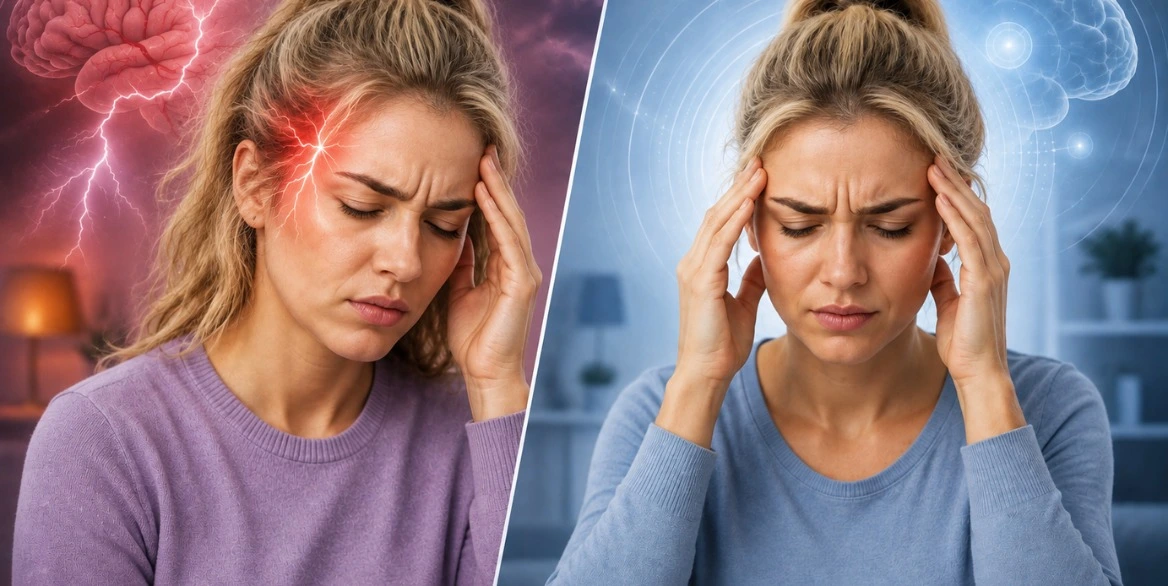
Migraine vs. Headache: Symptoms, Causes, Differences & Treatment Options#
The majority of people experience headaches occasionally. Still, when the pain is very intense, the episodes are frequent, and it is accompanied by nausea and/or light sensitivity or a change in visual perception, you might ponder: is this a headache or a migraine?
A migraine is not simply a severe headache. Actually, it is one of the neurological disorders whose characteristic symptoms include throbbing or pulsating pain and are often accompanied by the likes of nausea, vomiting and sensitivity to light and or sound. Headaches however are various types and subtypes resulting from various causes, accompanied by different symptoms and differing levels of intensity.
Having a good idea about the distinction between migraine and headache is extremely helpful because it will allow you to better understand and manage your symptoms, to pinpoint the probable triggers of the symptoms, and eventually, it will help you to decide when you need medical help.
What Is a Migraine?#
A migraine is a neurological disorder that can cause recurring attacks of moderate to severe head pain. A migraine headache often feels throbbing or pulsing and may affect one side of the head, although it can occur on both sides.
Migraine symptoms can include:
- • Throbbing or pulsating pain
- • Moderate to severe head pain
- • Nausea or vomiting
- • Sensitivity to light
- • Sensitivity to sound
- • Sensitivity to certain smells
- • Dizziness
- • Visual changes or other neurological symptoms
Not everyone experiences the same symptoms. Some people also experience an aura before or during a migraine attack.
What Is a Headache?#
A headache is the sensation of pain or discomfort in and around the head area, and it is most often an indication of a problem rather than a disease itself. Different types of headaches have different causes and patterns. Tension-type headaches are one of the types of headache that are most commonly experienced and may manifest like a band pressing the head or feeling of tightness/pressure.
Musculoskeletal disorders of the neck that are connected to a headache may involve the suboccipital muscles. Other headaches may involve changes on the scalp that are caused by pressure of a foreign body or growth, for example, tumors or cysts which exert pressure on the skin covering the skull or the underlying bone. The reason for the variation is that in one case, headaches are the main complaints, while in others, they may act as warning signs of some other medical condition.
For this reason, simply using the term "headache" does not exactly reveal the reason for your pain.
Migraine Symptoms vs. Headache Symptoms#
The symptoms can overlap, which can make it difficult to tell them apart.
Common migraine symptoms
Migraine symptoms often include throbbing pain, nausea, vomiting, and sensitivity to light or sound. The pain may be one-sided and can interfere with work, school, exercise, or everyday activities.
Common headache symptoms
The pain caused by headache could be indicative of its type. For example, a tension-type headache is known to produce some pressure or tighten feeling in head region ranging from mild to moderate level. It can of course be less disturbing than a migraine and generally does not have those accompanying features like nausea, hypersensitivity to light and sound.
Still, symptoms can differ and your physician will give you an assessment about what kind of headache you may have.
Migraine vs. Headache: What's the Difference?#
So, what is the difference between migraine and headache?
| Migraine | Headache |
|---|---|
| Neurological condition | Broad term covering many conditions |
| Often throbbing or pulsating | May feel like pressure, tightness, aching, or other pain |
| Can affect one or both sides | Location varies by headache type |
| May cause nausea or vomiting | Nausea is less typical in some common headache types |
| Often includes light or sound sensitivity | Sensory sensitivity depends on the type |
| Can significantly interfere with daily activities | Severity varies widely |
A migraine can technically be considered a type of headache disorder, but not every headache is a migraine.
What Causes Migraines and Headaches?#
Migraine causes are not completely understood, but genetics and changes in the nervous system are thought to play important roles. Certain triggers can also contribute to an attack.
Common migraine triggers may include:
- • Changes in sleep
- • Skipping meals
- • Stress
- • Bright lights
- • Strong smells
- • Weather changes
- • Certain foods
- • Hormonal changes
Headache causes are broader. Stress, muscle tension, dehydration, lack of sleep, illness, eye strain, and other factors can contribute to headaches. Some headaches can also be secondary to an underlying medical condition.
If your headaches are new, unusually severe, or changing in pattern, it's important to discuss them with a healthcare professional rather than assuming they are simply stress-related.
What Does a Migraine Feel Like?#
How does having a migraine pain feel? Migraine is an intense headache condition which usually brings a whole new level of pain that goes far beyond a simple headache.
The sensation is often that of a sharp or throbbing pain which may be concentrated in different parts of the head based on the side the person is suffering from. Getting up and moving around could increase the severity of the pain. The person might feel like throwing up, feel dizzy, be unable to cope with a bright light, or a loud sound. Migraine can leave you completely powerless and brain fogged. After a migraines, one is often physically drained. Migraines range in length from 4 to 72 hours when not treated, and the individual experience still differs greatly.
Migraine With Aura#
A migraine with aura can cause temporary neurological symptoms before or during the headache phase.
Aura may include:
- • Seeing flashing lights, bright spots, or zigzag patterns
- • Temporary visual changes
- • Tingling or numbness
- • Difficulty speaking
- • Other temporary neurological changes
Aura symptoms usually develop gradually and are reversible. They can last up to about an hour.
If you experience new neurological symptoms such as sudden weakness, speech problems, or vision loss, seek immediate medical evaluation because similar symptoms can occur with serious conditions such as stroke.
How to Get Rid of a Migraine#
In the case of a migraine, if a person wants to get rid of headache or wants to relieve the pain, the method of treatment would first and foremost depend on the severity and how frequently the person is getting migraines.
Rather than taking medicine right away, some people prefer to be in a room that is absolutely quiet and pitch-black, they hydrate themselves and decrease their sensory input for light and sound. Painkillers available on the shelves without a prescription may suffice for someone but may be just the contrary for someone else who needs specific migraine medicine.
Those whose migraines are too frequent or whose daily lives are being hampered could be referred by a physician for a preventive treatment. Also, a headache diary might be a useful way of revealing patterns and pinpointing possible triggers.
Do not overuse of pain medication. Frequent taking of treatment for headache can bring medication-overuse headaches.
How to Get Rid of a Headache#
The treatment of a headache greatly varies based on the cause.
Resting, staying hydrated, decreasing exposure to screens or bright light, and taking proper over-the-counter medication can ease the headache temporarily during sporadic mild headache bouts. Though, if you regularly suffer from headaches, your headaches get worse, or they start interrupting your work, life routine, you might want to get a second opinion from a doctor.
It's not enough to just eliminate the pain for a moment. On the contrary, figuring out your headache's type and source will lead you to make better treatment decisions.
Migraine Treatment#
Migraine therapies generally consist of two types: acute ones used to treat migraines once they appear and those to prevent migraines from happening.
The primary form of acute treatment is used right as the migraine begins and may involve the right choice between non-prescription medicines or prescription drugs. Preventive treatment but is administered regularly to minimize the chance, intensity, or duration of subsequent migraine episodes. People who have regular or incapacitating headaches are mostly candidates.
The treatment you choose will be a function of your specific symptoms, other medications you may be on, the nature of your medical history, and the frequency of your migraines. It would be a good idea to talk to a doctor on these matters and allow him or her to decide what treatment is best for you.
How to Prevent Migraines#
You may not be able to prevent every migraine, but identifying your personal triggers can help.
Try to:
- • Keep a consistent sleep schedule
- • Avoid skipping meals
- • Stay hydrated
- • Manage stress
- • Keep track of potential triggers
- • Limit known personal triggers when possible
- • Follow your healthcare professional's treatment plan
A migraine diary can be especially helpful. Record when attacks happen, how long they last, what you ate or drank, your sleep, stress levels, and any other noticeable patterns.
When Should You See a Doctor for a Headache?#
Although most headaches are a result of non-severe factors, there are situations where certain signs may need a quicker evaluation by a health professional.
It is advisable to go to a hospital immediately if you face a severe headache all of a sudden that can be characterized as the worst headache episode in your life. And, you should not hesitate to get the necessary care if you start feeling disoriented after a headache which leads to fainting, has seizures, is accompanied by a fever with high temperature symptoms, stiffness in the neck, lack of physical sensation or muscle response in a certain part of your body, is speaking or seeing affected, or has occurred after having struck your head (or a part of your head) to may cause injury.
You can also consult a specialist with no rush if your headaches start occurring more and more often, intensifying in each case, not responding to correct therapy even if treatment is continued as recommended and they have started to seriously interfere with your work, sleep (i.e. you can't have a regular pattern of sleeping now), or daily activities.
Get Online Help for Migraine and Headache#
Recurring migraine or headache pain can make everyday life harder. You don't have to figure out your symptoms alone.
With Humancare Connect, you can connect with a healthcare professional online to discuss recurring migraines, headache symptoms, possible triggers, and treatment options.
During a virtual consultation, a healthcare professional can review your symptoms and medical history and help determine the appropriate next step. Online care can be a convenient starting point when you need guidance for migraine or headache concerns.
If your symptoms are severe, sudden, or accompanied by neurological warning signs, seek emergency medical care rather than relying on an online consultation.
Frequently Asked Questions
1. What is the difference between migraine and headache?
2. What does a migraine feel like?
3. How long does a migraine last?
4. Can a headache turn into a migraine?
5. What triggers migraines?
6. Can migraines cause nausea?
7. What is migraine with aura?
8. How can I prevent migraines?
9. When should I see a doctor for a headache?
10. Can I get online treatment for migraine or headache?
Medical Disclaimer
This article is for general educational purposes only and is not a substitute for professional medical advice, diagnosis, or treatment. If you experience a sudden, severe, or unusual headache or concerning neurological symptoms, seek immediate medical attention.